Well, you’ve decided to launch your very own line of lingerie? This is wonderful news. It seems that the market for intimate wear is at an absolute high at the moment. The old-fashioned restrictive shapewear trends are gradually giving way to brands that put comfort, inclusiveness, modern materials and technologies, and innovative aesthetic features front and center.
However, let’s just be upfront here and admit that fashion can be extremely intimidating from the perspective of a newcomer. Concepts like tech pack creation, yield calculation, garment grading, and MOQ can appear utterly incomprehensible, especially if you lack any sort of experience in the field. It may easily become too much information to take in before sewing anything.
If you are a fashion designer who wishes to bring out your first collection without going crazy—or blowing through your savings in the process—look no further! Here’s your ultimate, straight-to-the-point manual on how it’s done.
1. Understand Why You Are Doing This (Discover Your Profitable Niche)
Don’t go and draw pretty pictures or stare into fabric swatches until you get dizzy. Fashion lingerie is an extremely wide field. The product range is extensive, from comfortable everyday cotton briefs and functional sports bras to luxurious silk matching lingerie sets and medical post-operative bras. In the fashion e-commerce business, there is only one rule: trying to serve everybody, you don’t sell anything.
How to Find the Gap in the Market?
Ask your friends what troubles them about lingerie, or look into your own wardrobe. Do the underwire bras dig into your ribs?
Have you been looking unsuccessfully for cute, comfortable, and functional bralettes for ladies with D+ cup size?
Can’t find any sustainable and biodegradable everyday lingerie options?
Go to Amazon, read the reviews on Reddit, or look at the reviews of any popular brand in the field. Pay attention to the 2-star and 3-star reviews. What are people upset about? Are they complaining about chafing seams, loss of elasticity, and lack of variety in skin tones?
Focus on one problem and promise yourself to solve it, and you’ve found your brand’s superpower.
2. Converting Ideas into a “Tech Pack”
To be able to make lingerie designs, you do not necessarily need to have exceptional skills in illustration or artistry. You can start with simple sketching using an iPad, or by posting some moodboards on Pinterest, as well as photos of clothes that catch your fancy with notes alongside them.
But you cannot simply send your nice sketch to the factory to get a perfectly made garment. Sketches will leave too many chances to go wrong. In order to manufacture your product, you have to send a Tech Pack (Technical Packet) to the factory.
What Actually is a Tech Pack?
A Tech Pack is something like a set of instructions or a recipe for your underwear. This is an accurate set of details that leaves no chance of misunderstanding. A professional tech pack consists of the following:
Technical Flat Sketches: Sketches that provide all technical details about garment construction, front, back, and inside-out views.
Bill of Materials (BOM): Essentially, your complete shopping list, listing all materials you require. For a basic bra, this consists of the main material, cup padding, elastic materials, underwiring, hooks and eyes, sliders, and sewing thread.
Measurements: Your measurements for your base size (example, Size M or 34B) along with a grading chart specifying precisely how many millimeters or inches will be added or subtracted for sizes Small, Large, Extra Large, etc.
Seaming: Specifying the type of seams required (flat lock or overlock stitch seaming, etc.), along with the number of stitches per inch.
If you are clueless about how to make a tech pack, there is nothing wrong with that. There is no need to enroll in a fashion school again to learn this! Freelance technical apparel designers can be hired at websites such as Upwork, Fiverr, and Behance who can help turn your initial designs into a complete tech pack for your product line for less than a thousand dollars.
3. Sourcing the Right Factory (Sourcing Strategy)
It’s definitely the scariest thing for newbies. Finding a clothing factory willing to take a risk on your new startup could be like looking for a needle in a haystack. The traditional manufacturing model of apparel factories is geared towards large quantities; they’d expect you to make an order of 3,000 to 5,000 items for each style, which simply does not fit into your budget of yours who is still trying things out.
So, when choosing a factory, consider checking out these three crucial characteristics:
A. Low, Practical MOQs, and Scalability
Make sure to find suppliers with an understanding of startups. Search for those that provide a Flexible MOQ solution. The ideal starting point is to have MOQs of approximately 500 units for each color/style of apparel. It will enable you to provide enough size options while keeping your inventory manageable.
It is also important that the pricing changes in favor of your company with every next order. As you become more popular, you will pay less per unit. Finally, make sure that there are pre-existing and high-quality blank apparel items in stock that you may combine to get the best idea about your brand before customizing.
B. Specialized Craftsmanship and Technology
The manufacturing process of lingerie requires sophisticated technology. This is because of the engineering involved in ensuring that the material can withstand washing and stretching, in addition to supporting body parts.
If you want to develop a product that incorporates advanced trends such as raw seams, lack of wires, or a seamless look with T-shirt bras, the traditional T-shirts and hoodies manufacturers will fail you. For this reason, you will need to find a specialized factory in intimate wear that has expertise in advanced processes such as:
Precision Dot Gluing & Bonding: Necessary for making seamless undergarments that do not require stitching.
High-Temperature Molding: Required in the creation of cups for the best structural lift without having wires that cause pain when fitted.
C. Open Communication
If you are a smaller brand, you will need a supplier that views you as an equal partner in the business relationship and not just someone who will place an order once and never be back again. Are they quick to respond to inquiries? Do they have good communication when addressing your technical concerns? Are they able to provide updates about your project?
4. The Sampling Stage: Test, Wear, and Repeat
Regardless of anything, never place an order for bulk production until you have tested and ensured that all the samples are correct. The sampling stage is when your electronic tech pack becomes a reality, and it’s your time to test, make mistakes, touch your fabrics, and get the fitting right.
How Your Samples Will Usually Go?
You will probably do this a couple of times until everything is perfect:
- 1.The Proto Sample: The manufacturer uses their existing fabrics to simply verify that the shapes and the designs on the tech pack are matching what you’ve specified.
- 2.The Salesman Sample: This sample is made using your exact fabrics, colors, and hardware.
How to Properly Test a Sample
When your sample comes in the mail, do not try it simply on a coat hanger or plastic model. Use a human fit model! Try it on yourself, or on someone who matches your ideal body type exactly.
The Movement Test: Walk, sit, bend down, and perform other actions that test how well your garment stays in place. Is the bra underband riding up as you raise your arm? Is the waistband of the underwear rolling down as you sit?
The Comfort Test: Test the garment over an 8-hour period. Are the shoulder straps chafing? Are there any irritations caused by the tags inside?
The Wash Test: Wash the sample a couple of times. Does it pill? Has the elastic lost its elasticity? Have the bonded edges come apart?
Provide your factory with a list of bulleted issues that should be addressed, along with photos or videos demonstrating the problems. An agile manufacturer should be able to deliver your samples within 1-2 weeks. When you have made final changes to your sample and are satisfied, the golden sample is signed off on and used as a standard for the whole order.
5. Protecting Your Design
In the ever-moving pace of the fashion industry, unfortunately, there is no shortage of piracy and imitations of designs. It is very disheartening indeed when months of work to create that one-of-a-kind bra design come back and slap you in the face through the emergence of a cheap imitation of your design even before you open your online shop.
You should protect yourself as a startup with your designs:
Non-Disclosure Agreements (NDAs): Always get a legally binding NDA before sharing your very detailed technical information and exclusive drawings and sketches of your designs with a factory.
Strategic Geography: In the case of experienced designers, many opt to seek out factories that do not exist in densely populated and traditionally congested textile manufacturing areas. Factories based in independent economic centers, such as Chengdu, for example, are by default protected by their isolation from other garment manufacturers. The fact that they are physically far from these centers reduces the likelihood of local competition spying on their operations, mold-making, and design production.
6. Bulk Production and Preparations for Shipping
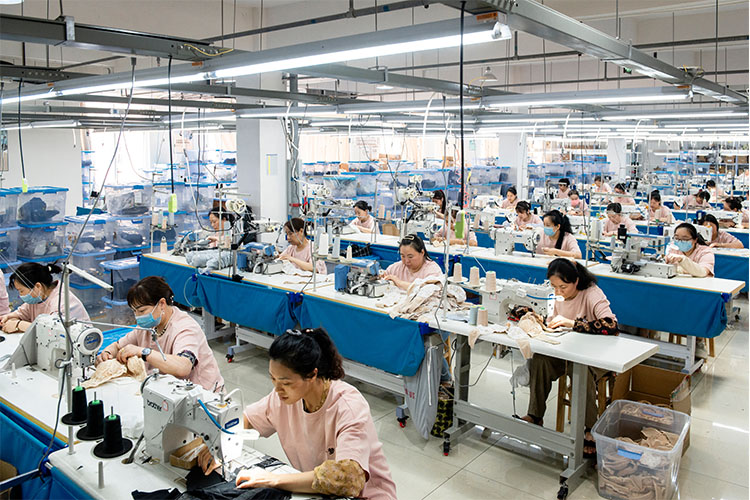
After the last sample approval and payment of your bulk production deposit, the factory moves on to bulk production. If the factory you chose makes use of automated and intelligent manufacturing (such as lasers cutting fabric and computers stitching the fabric), your chances of getting defective items become very low. Automated equipment guarantees that the 500th item packed in one box is of the same quality as the approved sample.
While the factory takes care of its work, all you need to do is start building your brand and creating buzz around it. One bulk production order may take anything between 20 and 30 days.
Checklist for Your Launch:
Create Your Virtual Boutique: Create a Shopify store that is user-friendly and visually appealing. Product descriptions should be transparent and concentrate on the feel, fit, and size.
Content Creation: Conduct a high-quality product photoshoot utilizing your finalized designs. On a budget, you could shoot lifestyle photographs using an iPhone and your friends to act as models under great lighting conditions.
Growing an Audience: Creating social media accounts just before your launch could be too late. Share behind-the-scenes footage about sketching, swatches, or even your entire creative process on TikTok and Instagram. Create an email landing page where fans can sign up for a “launch day 10% off discount”.
By the time the carrier has shipped your inventory to you, your audience will be eagerly awaiting your products.
Let’s Bring Your Vision to Life
Launching an intimate wear collection is a fantastic adventure, but you don’t have to go through the entire process of sourcing materials all alone. Our services are aimed at helping young, aspiring designers and entrepreneurs build their brand without feeling overwhelmed by the manufacturing process.
Here’s what you can expect when working with us: The complete flexible infrastructure needed for your success:
Low Start-Up Costs: Flexible production starting from 500 pieces per design/color with scalable pricing plans.
Speedy Product Development: 2-week prototypes to keep your business ahead of the competition.
High Levels of Consistency: Automation technology ensures retail-ready items with consistent quality.
Complete Control Over Your Order: Clear and precise shipping terms, along with completely private and secure manufacturing facilities.
| Production Phase | Required Timeline | MOQ | Key Deliverable / Data Focus |
| 1. Tech Pack Design | 3 – 5 Working Days | N/A | 100% complete digital blueprint & BOM |
| 2. Rapid Proto-Sampling | 7 – 14 Days (1-2 Weeks) | 1 Piece per style | Fitting, fabric stretch & wash testing |
| 3. Size-Grading Approval | 3 – 5 Working Days | N/A | Scaling patterns across all sizes (S to XL) |
| 4. Custom Production Run | 20 – 30 Working Days | 500 Pieces / style & color | Bulk manufacturing with automated tech |
| 5. Order Logistics & Shipping | 15 – 20 Working Days | Based on bulk order | Samples ship in 15-20 days; bulk follows |
Need a conceptual idea or a tech pack made up? Let’s connect now and talk about your project!